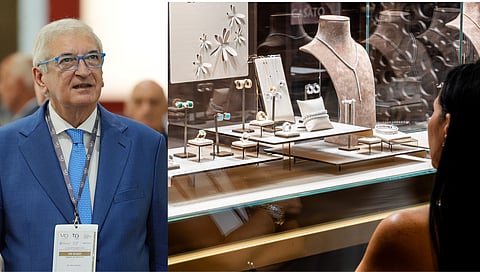

Vicenzaoro September 2026 moved into its third and fourth days with the focus shifting from the show's international participation and industry-wide discussions to how jewellery businesses are adapting to changing consumer behaviour and market conditions.
One of the clearest signals came from a digital marketing case study presented during a Confindustria Federorafi seminar. The study found that users reaching a jewellery brand's website through ChatGPT recorded a 15.9 per cent conversion rate, compared with 1.76 per cent for visitors arriving through organic Google searches.
The organisers stressed that the figures represent a specific case study rather than an industry-wide benchmark. However, they point to a growing role for AI in the jewellery purchase journey, with conversational platforms emerging as another route through which consumers discover brands.
For jewellery businesses, the shift also raises a new challenge: maintaining visibility within AI-driven discovery while preserving the human elements of retail. The seminar highlighted growing consumer interest in authenticity, real faces, craftsmanship and direct relationships with stores, alongside the transparency requirements coming with the AI Act.
The retail picture presented at the show also highlighted the importance of international visitors to Italian jewellery stores.
A Federpreziosi Confcommercio survey conducted with Format Research estimated that foreign tourists spent 910 million euros on jewellery and precious items in Italy in 2025, equivalent to around 13 per cent of annual jewellery-store revenue.
The research found that 75 per cent of Italian jewellery stores count foreign tourists among their customers, while almost one in five generates at least 10 per cent of its sales from them.
Craftsmanship, quality and Italian provenance remain central to this demand. Gold and silver jewellery were the most popular categories, while 84.8 per cent of foreign buyers surveyed said they would be willing to purchase Made in Italy jewellery again.
The latest export data presented at Vicenzaoro offers a similarly nuanced picture.
Italian gold jewellery exports reached 4.4 billion euros in the first part of 2026, down 15 per cent. However, excluding Turkey, which had been a major driver of export growth in 2024, exports increased 15 per cent. The US remained a particularly strong market, with exports rising 29 per cent.
The figures come against a more challenging global backdrop. Global gold jewellery demand fell 21 per cent in the first half of 2026, while Italian jewellery turnover declined 5 per cent in 2025 and a further 2 per cent in the first six months of this year.
Despite the contraction, turnover remains 50 per cent above 2019 levels, indicating that the sector continues to operate from a stronger base than before the pandemic.
The show's latest discussions also turned to one of the industry's established materials: Akoya pearls.
The Japan Pearl Exporters' Association used Vicenzaoro to launch a new narrative for Akoya in the US and European markets, with a particular focus on younger consumers.
The initiative, presented through The Future of Akoya Pearl, edited by Trendvision Jewellery + Forecasting co-founder Paola De Luca, places greater emphasis on the pearl's sustainability story, scarcity and luxury positioning.
Rising sea temperatures are putting pressure on oyster production, which is already significantly below levels recorded two decades ago. At the same time, strong Chinese demand and interest from European brands are supporting Akoya's positioning in the high-end and luxury segments.
The fourth day also reinforced the expanding role of technology in jewellery manufacturing.
The Jewellery Technology Forum examined additive manufacturing, artificial intelligence, digital production and Industry 4.0, including applications of MoldJet and Binder Jetting technologies.
The discussion reflects a wider shift in jewellery manufacturing: technology is increasingly being presented not simply as a production tool, but as a means of expanding design freedom, reducing waste and connecting research with industrial-scale jewellery production.
With the show's earlier coverage having established its scale and international participation, these latest developments add another layer to the Vicenzaoro story: the industry's next phase is being shaped as much by how consumers discover, buy and value jewellery as by where the products are showcased.
