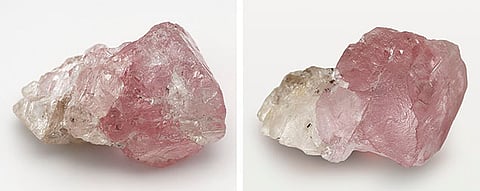

Miners in Botswana’s Karowe diamond mine have uncovered an extraordinary natural diamond weighing 37.41 carats, distinguished by a striking bi-colour appearance — one half dusty pink and the other transparent colourless.
The rough crystal measures approximately 24.3 × 16 × 14.5 mm, equivalent to about 7.5 grams, and displays a sharp planar boundary between its two colour zones — an exceptionally rare phenomenon in a crystal of this size.
According to analysis by the Gemological Institute of America (GIA) at its Botswana laboratory, the diamond’s dual colours likely reflect two distinct growth phases deep within the Earth’s mantle.
Experts explain that the pink portion of the stone formed via plastic deformation, where intense geological pressure alters the diamond’s crystal lattice, producing a pink hue without the need for trace impurities — a process that is extremely uncommon at such magnitude. The colourless zone appears to have crystallized later under more stable conditions.
Such starkly contrasting zones within a single seed crystal not only captivate gemologists but also offer unique scientific insights into the deep-Earth processes that influence coloured diamond formation.
Bi-coloured diamonds — especially those with pink hues — are among the rarest and most coveted segments of the diamond market. Pink diamonds generally command premium valuations, owing to their scarcity and the complexity of their formation.
Industry partners, including diamond cutting specialist HB Antwerp, have highlighted the stone’s potential to become one of the most significant pink diamonds ever polished, contingent on how it responds during the cutting and finishing stages.
For manufacturers and retailers, this discovery reignites interest in high-end coloured diamonds, particularly those with exceptional provenance and unorthodox structural characteristics.
The Karowe mine — operated by Lucara Diamond Corp. — has a strong track record of producing notable finds, from very large white diamonds to significant coloured stones. This latest discovery further underscores Botswana’s strategic role in supplying high-value, rare goods to the global diamond industry.
As the gemstone advances through analysis and potential cutting, its ultimate yield, cut quality, and market positioning will be closely watched by traders, cutters, and investors alike.
